
IMRaD explained: how a research paper is structured, and why
Most original research papers in medicine and the life sciences follow the same four-part structure: Introduction, Methods, Results and Discussion, usually shortened to IMRaD. Readers, editors and reviewers know where to look for each kind of information, so a paper that puts things in the expected place is easier to read and easier to review. This article explains what each section is for, why the order works, and how to keep the sections from blurring into each other.
Why it matters
IMRaD became the usual structure for medical research papers over the twentieth century. A survey of four general medical journals found that it began to appear in the 1940s, was used in about 80% of sampled articles by the 1970s, and was the only pattern used for original papers in the sample by the 1980s [1]. The ICMJE Recommendations, which many journals follow, describe the same division of the text for articles that report original research [2].
The structure matters because it mirrors what readers need to know. A good research report should say which question was asked and why, what was done, what was found, and what the findings mean [3]. Those four needs map directly onto the four sections. When information is missing or in the wrong section, readers can't judge or repeat the work: in studies of published trial reports, poor descriptions of interventions meant that 40% to 89% could not be replicated [3].
Key ideas
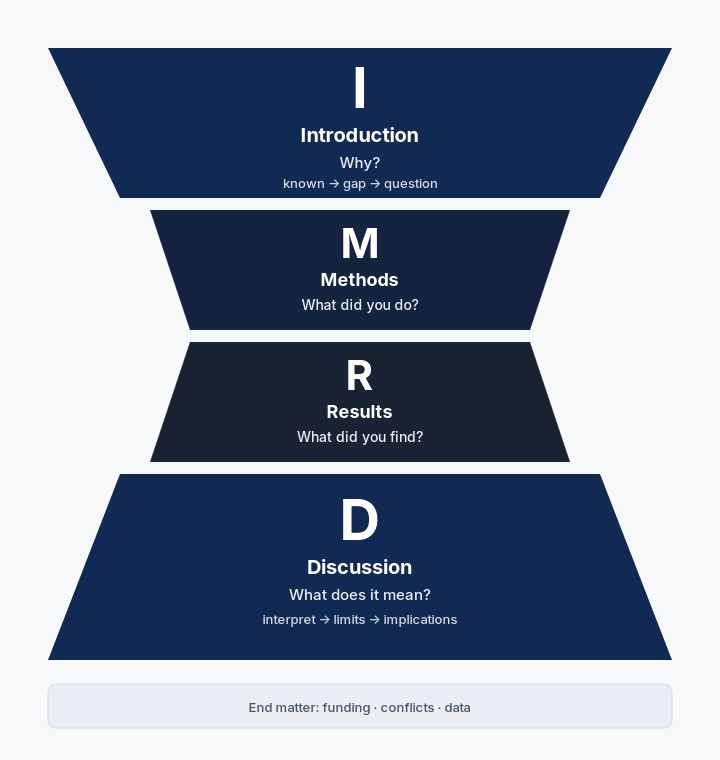
Introduction: why did you do this study?
The introduction moves from what is known, to what is not known, to the question your study answers. It is short, usually a few paragraphs. It ends with a clear statement of the objective or hypothesis. It is not a full literature review; cite the evidence that sets up the gap, ideally including any systematic review on the topic.
Methods: what did you do?
The methods give enough detail for a reader to understand, judge and, in principle, repeat the study. They cover the design, setting and dates, participants and how they were chosen, the intervention or exposure, the outcomes and how they were measured, the sample size, and the statistical methods. Ethics approval and consent usually belong here too. The reporting guideline for your design is the most useful checklist for this section, because most of its items sit in the methods.
Results: what did you find?
The results report what happened, in the order the methods set up, without interpretation. Start with the participants (how many were included, how many were lost and why), then the main outcome, then secondary and other analyses. Give numbers, not just P values: effect sizes with confidence intervals, and the counts behind percentages. Use tables and figures for detail and the text for the main points, without repeating every number.
Discussion: what does it mean?
The discussion interprets. A common shape is: the main finding in a sentence or two; how it fits with other evidence; strengths and limitations; and what the findings mean for practice or future research. Conclusions should stay within what the results can support. New results don't belong here.
Around the four sections
The title, abstract, and end matter (funding, conflicts of interest, data sharing, author contributions and acknowledgments) frame the IMRaD core. Many journals also want specific statements, such as trial registration, in a set place. Always check the target journal's instructions for authors.
When IMRaD doesn't fit
Case reports, narrative reviews, editorials, many qualitative papers, and most humanities scholarship use other structures. Their own guidelines or the journal's instructions take priority.
Worked example
Illustrative example (invented). Not a real study.
A fellow's first draft of a cohort study on an invented text-message reminder program has these six sentences. Where does each one belong?
- "Missed postpartum blood pressure checks are common, and reminder programs have been tested mainly in outpatient clinics."
- "We included all patients who gave birth at one hospital between January 2022 and December 2024 and had a diagnosis of hypertension in pregnancy."
- "The program clearly works and should be adopted everywhere."
- "Of 1,000 eligible patients, 500 enrolled in the program; 70 of them (14%) missed the check, compared with 110 of 500 (22%) who did not enroll."
- "Patients who enrolled may have differed from those who did not in ways we did not measure."
- "We estimated risk ratios with 95% confidence intervals and adjusted for distance from the clinic."
Sentence 1 is introduction. Sentences 2 and 6 are methods. Sentence 4 is results. Sentence 5 is a limitation, so it goes in the discussion. Sentence 3 doesn't belong anywhere as written: an observational study can't show that a program "clearly works", and a single-hospital study can't support "everywhere". A discussion sentence that stays within the data might read: "Enrollment was associated with fewer missed checks, but unmeasured differences between groups could explain some or all of this."
Common pitfalls
- Results in the methods. Numbers of participants included belong in the results; the methods describe how they were selected.
- Interpretation in the results. Words like "surprisingly" or "importantly" are a sign that discussion has crept in.
- New findings in the discussion. If a number matters, report it in the results first.
- An introduction that is a literature review. Keep it to what the reader needs to understand the question.
- A discussion that repeats the results. Summarize the main finding once, then interpret it.
- Conclusions that go beyond the design. Associations from observational data should not be written up as causes.
- Numbers that don't match. The same counts should appear in the abstract, text, tables and figures.
Quick self-check, in our own words
- My introduction ends with a clear objective or hypothesis.
- Someone could repeat my study from the methods alone.
- My results follow the order of my methods and contain no interpretation.
- Every number in the text matches the tables, figures and abstract.
- My discussion opens with the main finding and includes limitations.
- My conclusions stay within what my design can support.
- I have checked the target journal's instructions and the reporting guideline for my design.
Further reading
- Sollaci and Pereira trace the adoption of IMRaD in medical journals [1].
- Glasziou and colleagues describe how incomplete reports waste research [3].
- The explanation and elaboration papers for CONSORT 2025 [4] and STROBE [5] show, item by item, what readers need from the methods and results of trials and observational studies.
- Related Stetleaf Academy articles: How to choose the right reporting guideline for your study.
References
- Sollaci LB, Pereira MG. The introduction, methods, results, and discussion (IMRAD) structure: a fifty-year survey. J Med Libr Assoc. 2004;92(3):364-7. PMID: 15243643.
- International Committee of Medical Journal Editors. Recommendations for the conduct, reporting, editing, and publication of scholarly work in medical journals [Internet]. ICMJE; [updated regularly]. Available from: https://www.icmje.org/recommendations/
- Glasziou P, Altman DG, Bossuyt P, Boutron I, Clarke M, Julious S, et al. Reducing waste from incomplete or unusable reports of biomedical research. Lancet. 2014;383(9913):267-76. doi:10.1016/S0140-6736(13)62228-X. PMID: 24411647.
- Hopewell S, Chan AW, Collins GS, Hróbjartsson A, Moher D, Schulz KF, et al. CONSORT 2025 explanation and elaboration: updated guideline for reporting randomised trials. BMJ. 2025;389:e081124. doi:10.1136/bmj-2024-081124. PMID: 40228832.
- Vandenbroucke JP, von Elm E, Altman DG, Gøtzsche PC, Mulrow CD, Pocock SJ, et al. Strengthening the Reporting of Observational Studies in Epidemiology (STROBE): explanation and elaboration. PLoS Med. 2007;4(10):e297. doi:10.1371/journal.pmed.0040297. PMID: 17941715.