
How to choose the right reporting guideline for your study
A reporting guideline is a consensus-built list of what a report of a particular kind of study should contain, so that readers can understand what was done and what was found. Using the wrong guideline, or none, is a common reason a manuscript comes back with requests for missing details. This article shows how to pick the guideline that fits your design, how to spot extensions, and how to make sure you have the current version.
Why it matters
Research that is not reported clearly enough to be understood or repeated wastes the time and resources that went into it, and incomplete reporting has been documented across trials, diagnostic studies, observational research, prediction studies, surveys and qualitative work [1]. Reporting guidelines exist to close those gaps. The EQUATOR Network was set up as an international initiative to promote good reporting of health research and the wider use of reporting guidelines, and it keeps a free online library of them [2].
Guidelines also seem to make a difference in practice. A Cochrane methodology review of 50 evaluations found that trials published in journals that endorse CONSORT tended to report key methods more completely than trials in other journals, although the included evaluations were not randomised and the authors described reporting as still sub-optimal [3].
Key ideas
Start from the design, not the topic
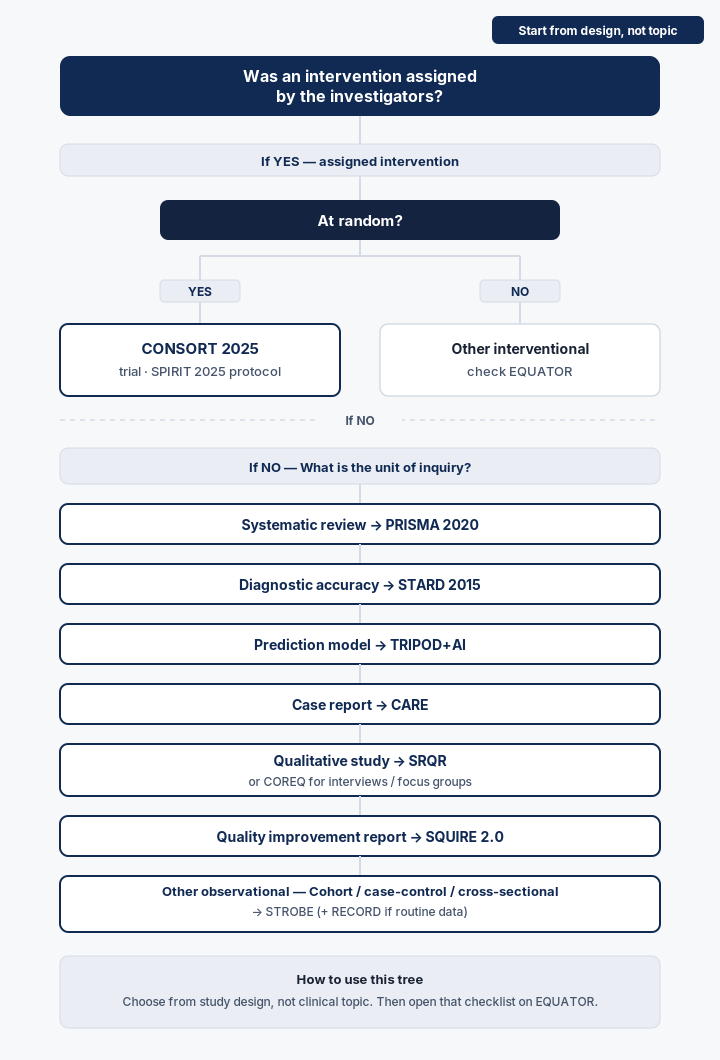
The guideline follows the design of the study, not its subject. Two studies of the same condition can need different guidelines. Ask yourself one question first: did the investigators assign the intervention, and if so, at random?
| If your study is… | Start with |
|---|---|
| A randomized trial | CONSORT 2025 [4] |
| A protocol for a randomized trial | SPIRIT 2025 [5] |
| A cohort, case-control or cross-sectional study | STROBE [6] |
| An observational study using routinely collected data (health records, registries, claims) | STROBE plus RECORD [7] |
| A systematic review, with or without meta-analysis | PRISMA 2020 [8] |
| A case report | CARE [9] |
| A diagnostic accuracy study | STARD 2015 [10] |
| A study that develops or evaluates a prediction model | TRIPOD+AI [11] |
| A qualitative study | SRQR [12], or COREQ for interviews and focus groups [13] |
| A quality improvement report | SQUIRE 2.0 [14] |
Check for an extension
Many guidelines have extensions for particular designs (for example cluster or pilot trials), data sources (RECORD builds on STROBE) or topics. Use the main guideline plus any extension that applies, and say in your methods which ones you used.
Some guidance cuts across designs. TIDieR helps you describe an intervention in enough detail to repeat it [15]. SAGER covers the reporting of sex and gender [16]. SAMPL covers basic statistical reporting [17]. These sit alongside your main guideline rather than replacing it.
Use the current version
Guidelines are updated. CONSORT 2025 and SPIRIT 2025, for example, replaced the 2010 and 2013 versions [4,5]. Before you start, check the guideline's own website or the EQUATOR library for the latest version, and cite that version. Many extensions were written for an earlier version of their parent guideline, so item numbers may not line up; note which versions you used.
Use it early, not at the end
A reporting guideline tells you what to report, not how to design the study, and it doesn't measure whether a study was well done. It is still worth reading at the planning stage, because some items ask for information you can only collect while the study is running. The authors of a randomized trial of peer review concluded that authors should know what reporting guidelines will ask for at the very beginning of their study [18].
When nothing fits
Some designs have no single, widely used guideline. Search the EQUATOR library by study type. If nothing matches, use the closest guideline as a structure, follow the target journal's instructions, and say plainly what you used. Don't claim to follow a guideline that doesn't cover your design.
Worked example
Illustrative example (invented). Not a real study.
A resident plans to compare postpartum readmission within 30 days between patients who had a planned cesarean birth and patients who had an unplanned one, using five years of electronic health records from one hospital.
- Name the design. Nobody assigned the type of birth, and the groups are followed from birth to readmission. This is an observational cohort study, so the starting point is STROBE, cohort version [6].
- Check the data source. The data come from routinely collected records, so the RECORD extension applies as well [7]. It asks, among other things, how the groups and outcomes were identified in the records, for example which codes were used.
- Check cross-cutting guidance. There is no assigned intervention, so TIDieR does not apply. The analysis will compare readmission risks with and without adjustment, so SAMPL's guidance on basic statistical reporting is a useful companion [17].
- Check the version and the journal. The resident downloads the current checklists from the guideline websites and reads the target journal's instructions, which ask for a completed checklist with page numbers.
- Say it in the methods. "We report this study following the STROBE statement (cohort checklist) and the RECORD extension for studies using routinely collected health data."
Six months later the resident adds a model to predict which patients are likely to be readmitted. That part of the work is a prediction model study, so TRIPOD+AI now applies to it too [11].
Common pitfalls
- Choosing by habit. Using whichever checklist a colleague used last time, rather than the one for your design.
- Using CONSORT for a non-randomized comparison. CONSORT is written for randomized trials. A before-and-after or registry comparison needs a different guideline.
- Citing an old version. Check the year and version before you cite.
- Ignoring extensions. A cluster trial or a registry study has extra items to report.
- Ticking without reporting. A completed checklist is only useful if each item points to the place in the manuscript where it is reported, or explains why it doesn't apply.
- Leaving it to the end. Some items can't be fixed after the data are collected.
Quick self-check, in our own words
- I can name my study design in a few words.
- I have identified the main guideline for that design, in its current version.
- I have checked for an extension for my design, data source or topic.
- I have considered cross-cutting guidance on interventions, sex and gender, and statistics.
- I have read the target journal's instructions about checklists.
- My methods section names each guideline and version I followed.
- Every item is either reported, with a page or line number, or explained.
Further reading
- The explanation and elaboration papers for CONSORT 2025 [19], STROBE [20] and PRISMA 2020 [21] explain each item with examples.
- Simera and colleagues describe the EQUATOR Network and its resources [2].
- Related Stetleaf Academy articles: CONSORT 2025 overview, STROBE for observational studies, PRISMA 2020 for systematic reviews, and the research project roadmap.
References
- Glasziou P, Altman DG, Bossuyt P, Boutron I, Clarke M, Julious S, et al. Reducing waste from incomplete or unusable reports of biomedical research. Lancet. 2014;383(9913):267-76. doi:10.1016/S0140-6736(13)62228-X. PMID: 24411647.
- Simera I, Moher D, Hirst A, Hoey J, Schulz KF, Altman DG. Transparent and accurate reporting increases reliability, utility, and impact of your research: reporting guidelines and the EQUATOR Network. BMC Med. 2010;8:24. doi:10.1186/1741-7015-8-24. PMID: 20420659.
- Turner L, Shamseer L, Altman DG, Weeks L, Peters J, Kober T, et al. Consolidated standards of reporting trials (CONSORT) and the completeness of reporting of randomised controlled trials (RCTs) published in medical journals. Cochrane Database Syst Rev. 2012;11(11):MR000030. doi:10.1002/14651858.MR000030.pub2. PMID: 23152285.
- Hopewell S, Chan AW, Collins GS, Hróbjartsson A, Moher D, Schulz KF, et al. CONSORT 2025 statement: updated guideline for reporting randomised trials. BMJ. 2025;389:e081123. doi:10.1136/bmj-2024-081123. PMID: 40228833.
- Chan AW, Boutron I, Hopewell S, Moher D, Schulz KF, Collins GS, et al. SPIRIT 2025 statement: updated guideline for protocols of randomised trials. BMJ. 2025;389:e081477. doi:10.1136/bmj-2024-081477. PMID: 40294953.
- von Elm E, Altman DG, Egger M, Pocock SJ, Gøtzsche PC, Vandenbroucke JP. The Strengthening the Reporting of Observational Studies in Epidemiology (STROBE) statement: guidelines for reporting observational studies. PLoS Med. 2007;4(10):e296. doi:10.1371/journal.pmed.0040296. PMID: 17941714.
- Benchimol EI, Smeeth L, Guttmann A, Harron K, Moher D, Petersen I, et al. The REporting of studies Conducted using Observational Routinely-collected health Data (RECORD) statement. PLoS Med. 2015;12(10):e1001885. doi:10.1371/journal.pmed.1001885. PMID: 26440803.
- Page MJ, McKenzie JE, Bossuyt PM, Boutron I, Hoffmann TC, Mulrow CD, et al. The PRISMA 2020 statement: an updated guideline for reporting systematic reviews. BMJ. 2021;372:n71. doi:10.1136/bmj.n71. PMID: 33782057.
- Gagnier JJ, Kienle G, Altman DG, Moher D, Sox H, Riley D. The CARE guidelines: consensus-based clinical case reporting guideline development. J Med Case Rep. 2013;7:223. doi:10.1186/1752-1947-7-223. PMID: 24228906.
- Bossuyt PM, Reitsma JB, Bruns DE, Gatsonis CA, Glasziou PP, Irwig L, et al. STARD 2015: an updated list of essential items for reporting diagnostic accuracy studies. BMJ. 2015;351:h5527. doi:10.1136/bmj.h5527. PMID: 26511519.
- Collins GS, Moons KGM, Dhiman P, Riley RD, Beam AL, Van Calster B, et al. TRIPOD+AI statement: updated guidance for reporting clinical prediction models that use regression or machine learning methods. BMJ. 2024;385:e078378. doi:10.1136/bmj-2023-078378. PMID: 38626948.
- O'Brien BC, Harris IB, Beckman TJ, Reed DA, Cook DA. Standards for reporting qualitative research: a synthesis of recommendations. Acad Med. 2014;89(9):1245-51. doi:10.1097/ACM.0000000000000388. PMID: 24979285.
- Tong A, Sainsbury P, Craig J. Consolidated criteria for reporting qualitative research (COREQ): a 32-item checklist for interviews and focus groups. Int J Qual Health Care. 2007;19(6):349-57. doi:10.1093/intqhc/mzm042. PMID: 17872937.
- Ogrinc G, Davies L, Goodman D, Batalden P, Davidoff F, Stevens D. SQUIRE 2.0 (Standards for QUality Improvement Reporting Excellence): revised publication guidelines from a detailed consensus process. BMJ Qual Saf. 2016;25(12):986-92. doi:10.1136/bmjqs-2015-004411. PMID: 26369893.
- Hoffmann TC, Glasziou PP, Boutron I, Milne R, Perera R, Moher D, et al. Better reporting of interventions: template for intervention description and replication (TIDieR) checklist and guide. BMJ. 2014;348:g1687. doi:10.1136/bmj.g1687. PMID: 24609605.
- Heidari S, Babor TF, De Castro P, Tort S, Curno M. Sex and Gender Equity in Research: rationale for the SAGER guidelines and recommended use. Res Integr Peer Rev. 2016;1:2. doi:10.1186/s41073-016-0007-6. PMID: 29451543.
- Lang TA, Altman DG. Basic statistical reporting for articles published in biomedical journals: the "Statistical Analyses and Methods in the Published Literature" or the SAMPL Guidelines. Int J Nurs Stud. 2015;52(1):5-9. doi:10.1016/j.ijnurstu.2014.09.006. PMID: 25441757.
- Cobo E, Cortés J, Ribera JM, Cardellach F, Selva-O'Callaghan A, Kostov B, et al. Effect of using reporting guidelines during peer review on quality of final manuscripts submitted to a biomedical journal: masked randomised trial. BMJ. 2011;343:d6783. doi:10.1136/bmj.d6783. PMID: 22108262.
- Hopewell S, Chan AW, Collins GS, Hróbjartsson A, Moher D, Schulz KF, et al. CONSORT 2025 explanation and elaboration: updated guideline for reporting randomised trials. BMJ. 2025;389:e081124. doi:10.1136/bmj-2024-081124. PMID: 40228832.
- Vandenbroucke JP, von Elm E, Altman DG, Gøtzsche PC, Mulrow CD, Pocock SJ, et al. Strengthening the Reporting of Observational Studies in Epidemiology (STROBE): explanation and elaboration. PLoS Med. 2007;4(10):e297. doi:10.1371/journal.pmed.0040297. PMID: 17941715.
- Page MJ, Moher D, Bossuyt PM, Boutron I, Hoffmann TC, Mulrow CD, et al. PRISMA 2020 explanation and elaboration: updated guidance and exemplars for reporting systematic reviews. BMJ. 2021;372:n160. doi:10.1136/bmj.n160. PMID: 33781993.